Up-minus-down Pip Count
The Up-minus-down Pip Count (or the Up–Down Count for short) is a pip counting method that computes the relative pip count, that is, the pip count of the opponent minus the pip count of the player. The advantage of this method is its speed and simplicity. The count is inspired by the 321 Colourless Pip Count and is itself colorless.
Like the 321 Colourless Count, we can ignore the color of the checkers and the counting process comes in two stages, the first giving an approximate count and the second an adjustment to get the exact relative count. The second stage is identical to that of the 321 method, and the approximation stage yields the same approximate count as the 321 method. We believe the arithmetic in the first stage is simpler in the Up–Down count than the 321 count. For instance, unlike 321, no checker is ever multiplied by more than one number, reducing mental bookkeeping and because there are cancellations, the numbers remain smaller.
We first introduce some standard terminology (e.g., triads and half-crossovers), then we give a step-by-step guide on how to compute the count, and we end with a derivation of the count.
Triads and crossovers
Like many pip counting methods, the Up–Down Count relies on the notion of a half-crossover, which we now define. First, we need to break the board into eight triads, which are groups of three points: 1-2-3, 4-5-6, … , 22-23-24. We number the triads from $T_1$ through $T_8$ starting with the triad closest to the player’s home board and proceeding opposite to the direction of bear-off.
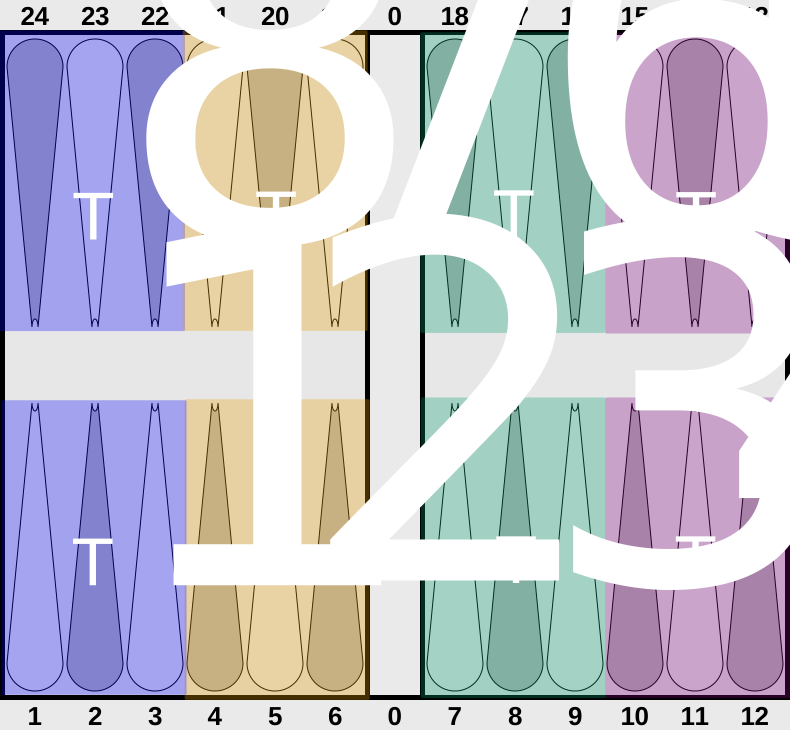
Orientation note.
All diagrams fix a particular board orientation, with the player bearing off to the left and the upper half of the board meaning farther from the player’s home board. If instead you are bearing off to the right, simply mirror the diagrams left–right; the Up–Down Count depends only on relative position and is unchanged.
A half-crossover is when a checker passes from one triad to the next, so from $T_i$ to $T_{i+1}$. The basic idea in many pip counting methods is to get a count of the number of half-crossovers one needs to get to a certain location on the board.
Example Count
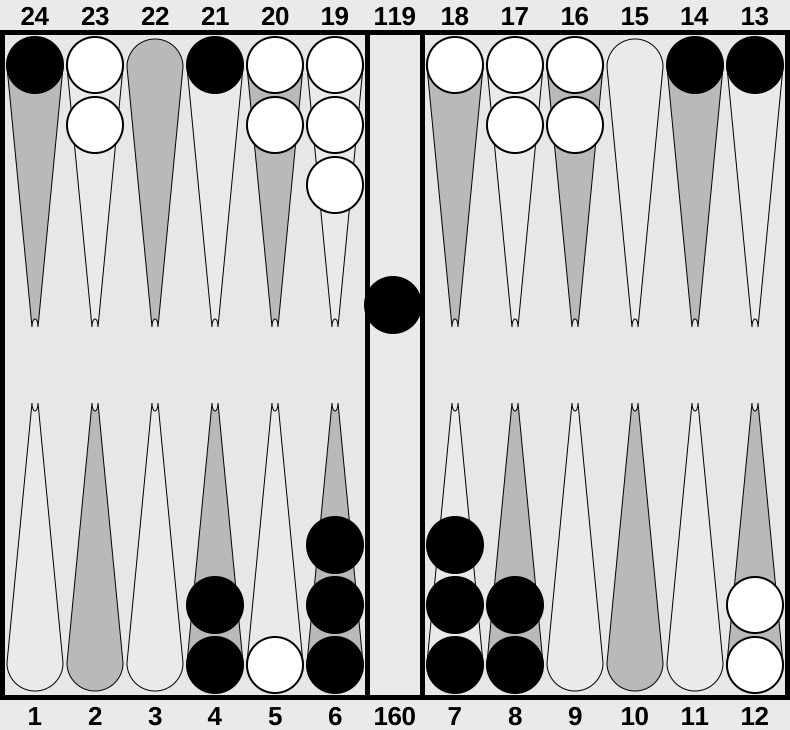
We exhibit the Up–Down Count by working through an example. Here is the position we will consider (black’s home board is the bottom left part of the board):
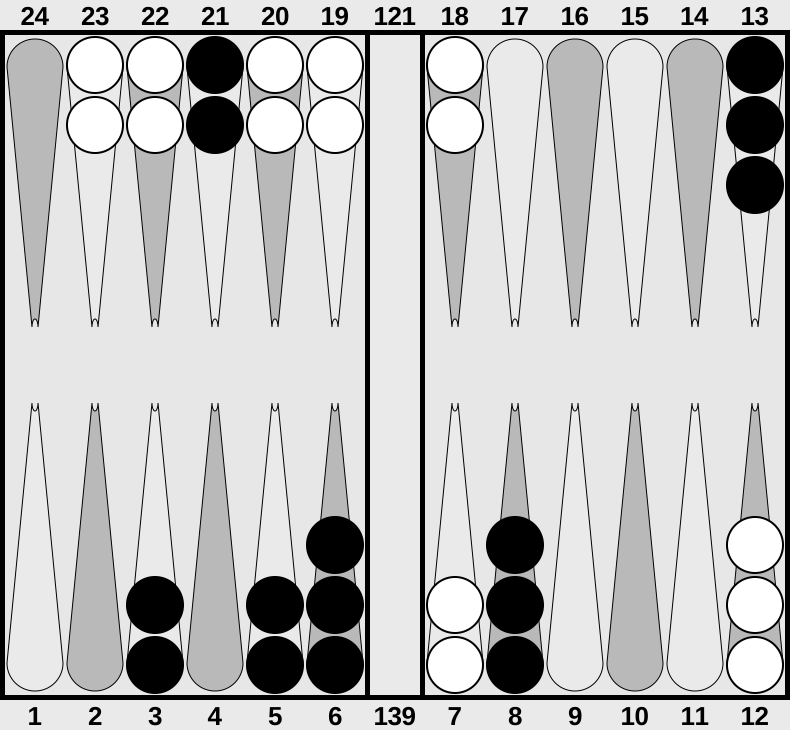 You might imagine that black has rolled double 5s and needs to decide whether they should run with the back checkers. This is the exact scenario where the Up–Down Count is very useful.
To help visualize the count, we will decorate the board as follows:
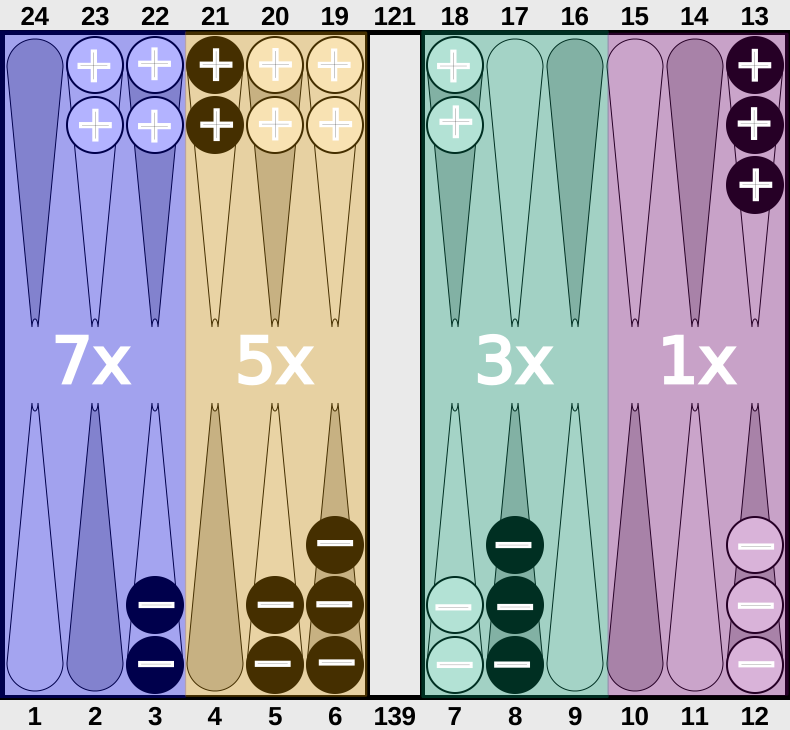 We have grouped the triads vertically into 4 pairs and we have assigned every checker on the upper half of the board a positive charge and each checker on the bottom half of the board a negative charge.
Stage 1 (Approximate count)
For each pair of triads, compute the net charge and multiply by the multiplier indicated in the figure. Add these values together, then divide the result by 2 and multiply by 3. The result is the approximate relative pip count. This procedure can be written compactly as\[ [\textcolor{blue}{7(t_8-t_1)} +\textcolor[rgb]{0.902,0.624,0.000}{5(t_7-t_2)} +\textcolor[rgb]{0.000,0.620,0.451}{3(t_6-t_3)} +\textcolor{purple}{(t_5-t_4)}] \times \frac12 \times 3 \]where $t_i$ is the number of checkers in the $i^{\text{th}}$ triad $T_i$.
In practice, you would most likely do this arithmetic in two steps. Let’s work through our example. First, let’s deal with the charge and multipliers: \[ {\color{blue}7(4-2)}+{\color{#E69F00}5(6-5)}+{\color{#009E73}3(2-5)}+{\color{purple}(3-3)} = 14+5-9+0=\mathbf{10} \]
The number computed is always even (to see this, note that each coefficient is odd and the total number of checkers is 30, so the bracketed sum is even). To finish, divide this quantity by 2 and multiply by 3.\[ \text{relative pip count }\approx(\mathbf{10} \div 2) \times 3 = \boxed{15}. \]The count is positive, so that means white is ahead by approximately 15 pips. We can see the actual relative pip count is 18, so we are within 3 pips. And that’s it!
Interpreting sign
By convention, the relative pip count is computed as the opponent’s pip count minus the player’s pip count. Therefore, a positive relative pip count means the opponent (white here) is ahead and a negative relative pip count means the player (black here) is ahead.
Stage 2 — Optional (Precise count)
If you want to get the exact relative pip count, you have to make unit adjustments. This process is identical to the unit adjustments in the 321 Colourless Count and we refer the reader to the unit adjustments write-up on Backgammon101 for a detailed discussion. However, for completeness, we give a quick description.
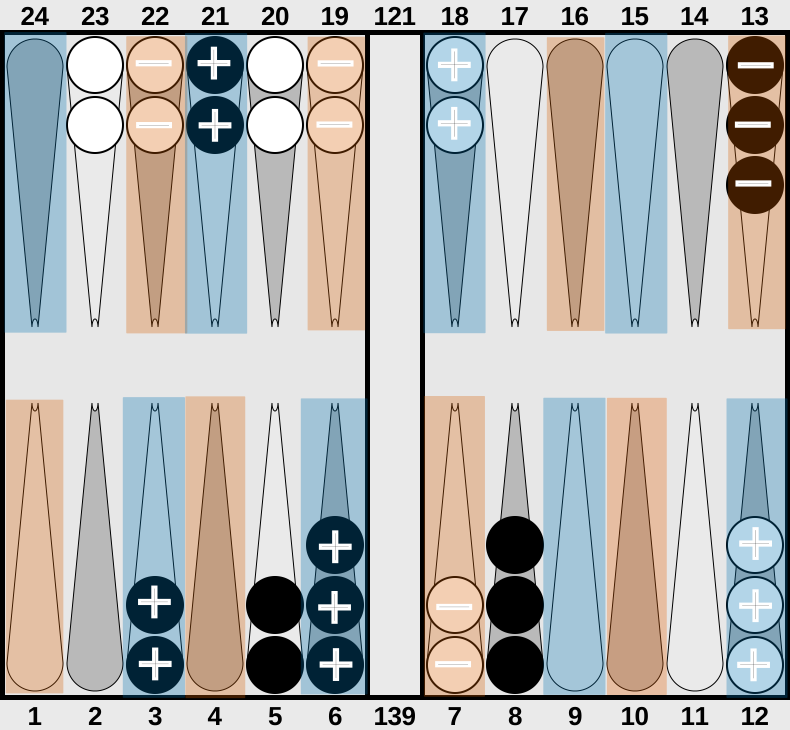 The figure highlights the checkers contributing +1 and -1 unit adjustments to the relative pip count. In each triad, look only at the two outer points:
- point nearer your home board → subtract 1 pip for each checker
- point nearer the opponent’s home board → add 1 pip for each checker.
The reasoning for these corrections will be clear from the assumption we make in order to derive the approximate count (see the Derivation section below). In our example, we now make our final adjustment:\[ \text{relative pip count} = 15 + \bigl(\textcolor[rgb]{0.000,0.447,0.698}{12}-\textcolor[rgb]{0.835,0.369,0.000}{9}\bigr) = \boxed{18} \]
Over the board, you would want to do some natural cancellations rather than acutally compute $12-9$, for example, the positive and negative checkers cancel each other out in the seventh triad $T_7$ and the checkers on the 13 and 12 points also cancel each other. As you practice, these type of cancellations can happen quickly.
Example 2 (checkers on the bar)
Let us consider another example, but this time with a checker on the bar. Here is the position (black’s home board is again the bottom left part of the board):
Checkers on the bar or borne off
We view any black checker on the bar as lying in the $8^\text{th}$ triad $T_8$, and any white checker on the bar as lying in the $1^\text{st}$ triad $T_1$. Though not present in this example, a black checker that has been borne off is treated as lying in $T_1$, while a white checker that has been borne off is treated as lying in $T_8$. These conventions preserve both the formula and the half-crossover interpretation of the count.
Succinctly, a checker not on the board is counted in the triad it is closest to.
For the Stage 2 unit adjustment, each such checker contributes two pips:
- add $2$ pips for each of your checkers on the bar and for each checker your opponent has borne off;
- subtract $2$ pips for each checker your opponent has on the bar and for each checker you have borne off.
The count
Let’s decorate the board again for the sake of visualizing the count.
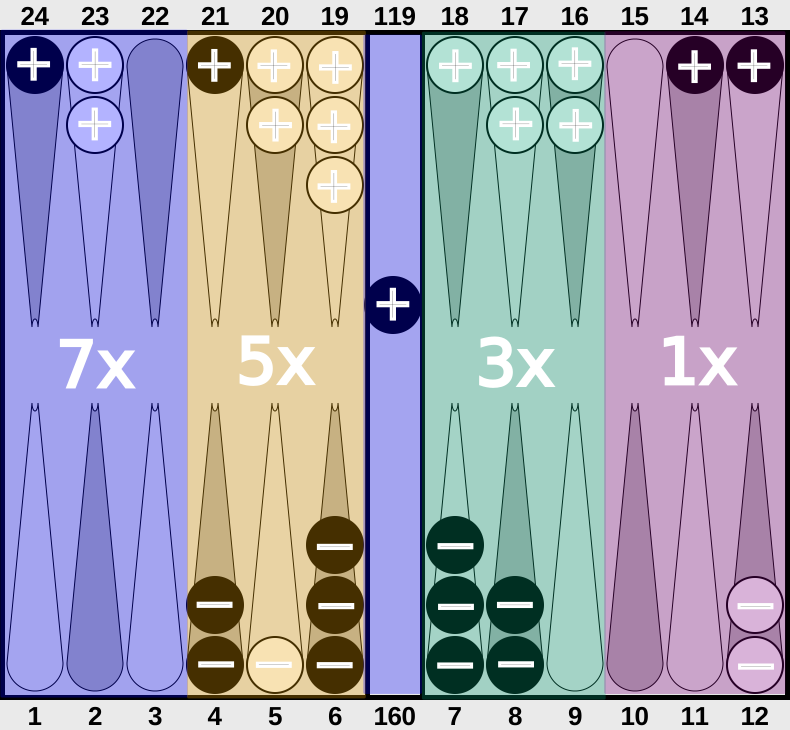 Observe that we now colored the bar the same color as the first vertical triad pair. Our Stage 1 computation is as follows: \[ {\color{blue}7(4-0)}+{\color{#E69F00}5(6-6)}+{\color{#009E73}3(5-5)}+{\color{purple}(2-2)} = 28+0+0+0=\mathbf{28}. \]Notice in this example many of the terms cancel out! Now, to get our count, we divide by 2 and multiply by 3: \[ \text{relative pip count} \approx 3\times (\mathbf{28}\div2) = \boxed{42}.\]This tells us that black down by approximately 42 pips, and we see the actual relative pip count is 41, so we are off by a single pip.
Derivation
We now turn to deriving the count, proving that it computes the relative pip count, under a given assumption.
Assumption: We will assume that all checkers are on the 2-, 5-, 8-, 11-, 14-, 17-, 20-, and 23-points. In other words, the only points with checkers on them are those numbered 2 modulo 3. (We have to imagine that these points have checkers of both colors on them.)
This assumption defines the reference positions used in the derivation; real positions are handled by unit adjustments exactly as in the 321 method.
Given a position, we will edit the position step-by-step so that 15 checkers end up on the 11 point and 15 checkers end up on the 14 point. This final position has zero relative pip count, so if we keep track of how the count changes at each step, we will have recovered the original relative pip count.
With our assumption, 1 half-crossover = 3 pips, so we will start by counting half-crossovers.
Let’s focus on the bottom part of the board and getting all the checkers to the 11 point. If a checker is in $T_1$, then it needs 3 half-crossovers to get to $T_4$; if it is in $T_2$, then it needs 2 half-crossovers; and if it is in $T_3$, then it needs 1 half-crossover. Therefore, letting $t_i$ denote the number of checkers in $T_i$, to get all checkers in the bottom half of the board to the 11 point requires \[ 3t_1+2t_2+t_3 \] half-crossovers. Similarly, to get all the checkers on the top half of the board to the 14 point requires \[ 3t_8+2t_7+t_6 \] half-crossovers.
After performing these half-crossovers, all checkers are on the 11 point and the 14 point. Suppose $c_{11}$ and $c_{14}$ are the number of checkers on the 11- and 14-point, respectively. We want 15 checkers on each point: to accomplish this requires another \[ \frac{|c_{14}-c_{11}|}{2} \] half-crossovers. The absolute value reflects the number of required half-crossovers; the direction (and hence sign) is accounted for below. Note that \[ c_{14} = t_8+t_7+t_6+t_5 \] and \[ c_{11}=t_1+t_2+t_3+t_4. \] We now need to convert this into a pip count. The first step is to understand how to appropriately assign signs to the half-crossovers above. In a given position, observe that if we move a checker from $T_i$ to $T_{i+1}$, then the relative pip count increases. And if we move a checker from $T_{i}$ to $T_{i-1}$, then the relative pip count decreases.
But now remember, we are “undoing” our current position to get to a reference position, so the contribution to the original relative pip count is the negation of these changes.
Putting this all together, we have that in a given position satisfying the assumption above, the relative pip count is \[3\times [3t_8+2t_7+t_6-3t_1-2t_2-t_3+\frac12(t_8+t_7+t_6+t_5-t_1-t_2-t_3-t_4)].\]Rearranging the terms, we obtain\[ 3 \times \frac12 \times [{\color{blue}7(t_8-t_1)}+{\color{#E69F00}5(t_7-t_2)}+{\color{#009E73}3(t_6-t_3)}+{\color{purple}(t_5-t_4)}].\]This is the exact count we compute in our examples. We have therefore proven the following:
Theorem (Up-minus-down Pip Count). If all checkers are on the points whose numbers are equal to 2 modulo 3, then the relative pip count is equal to \[ 3 \times \frac12 \times [{7(t_8-t_1)}+{5(t_7-t_2)}+{3(t_6-t_3)}+{(t_5-t_4)}],\]where $t_i$ is the number of checkers in the $i^\text{th}$ triad $T_i$.
Written by Nicholas G. Vlamis, February 2026